Completability, Sufficiency and Excitability
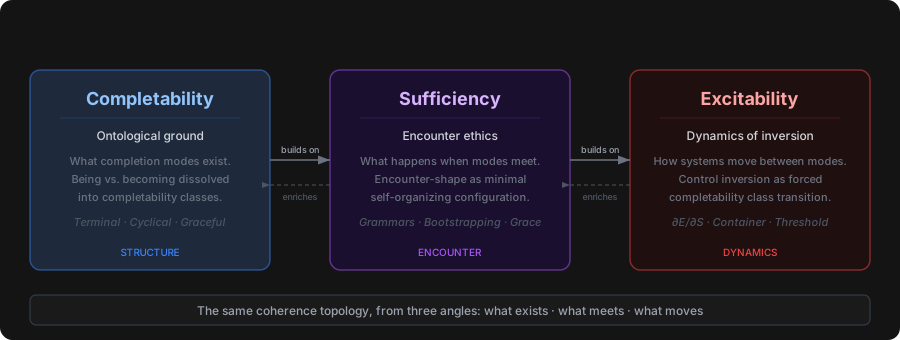
Philosophy has two classical orders: the order of being (what exists) and the order of knowing (how we access it). These three papers develop what both presuppose — coherence: which constructions hold together. Not a third order standing beside the two, and not a realm or a substance, but the condition of both — the prerequisite on which knowing and being each depend, the state each is in when it holds, the consequence each closure leaves behind. Constraint without a constraining thing. This turns out to have consequences for ethics, cybernetics, and consciousness that neither order alone can reach.
The Condition of Both — Completability
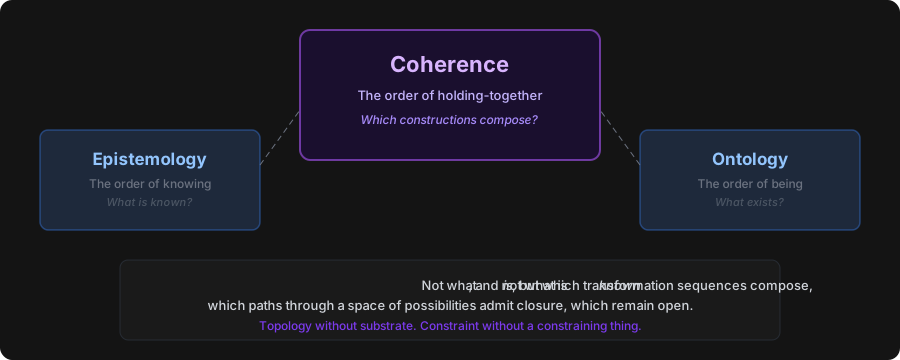
The Platonist correctly identifies that mathematical structure constrains from “outside” the constructor. The constructivist correctly denies that unconstructed objects exist. Coherence dissolves the binary: constraint isn’t a thing but the topology of what holds together — primes aren’t infinite because that fact pre-exists, but because no coherent completion makes them finite. The coercion is real. The realm is not.
Three Modes of Completion
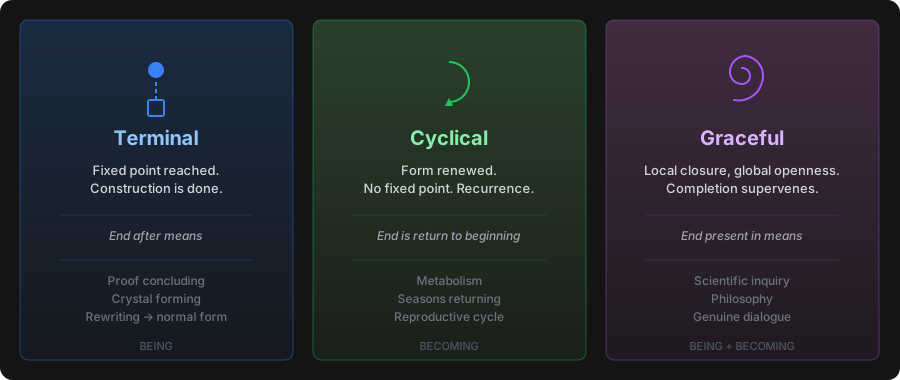
Terminal. A proof concludes. A crystal forms. A rewriting sequence reaches normal form. The end comes after the means.
Cyclical. The organism renews. Metabolism closes and reopens. Seasons return. The system sustains its form through recurrence without inquiring into the form it sustains.
Graceful. Scientific inquiry: each result generates more precise forms of the question that produced it. Completes locally while remaining globally open. Completion supervenes — “the bloom on the face of youth.” You meet the conditions for it, and it arrives or it does not.
What Happens When Modes Meet — Sufficiency
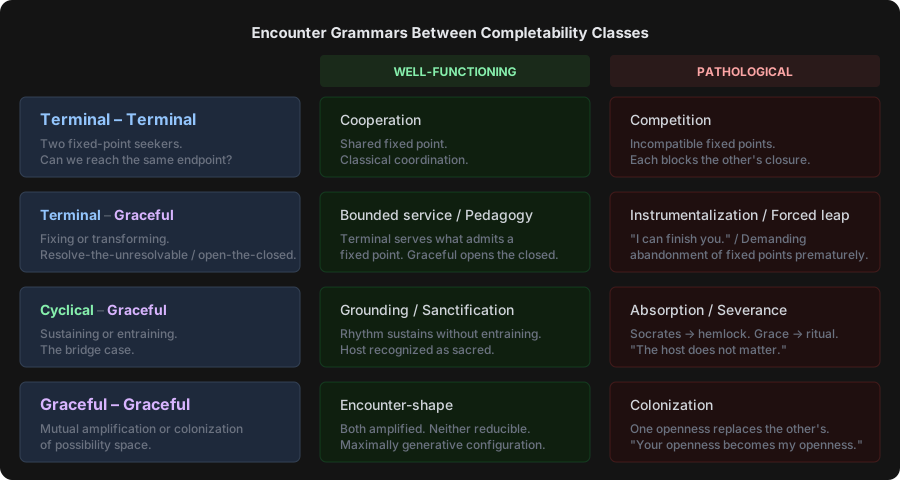
Each encounter between completability classes has a characteristic grammar. Which moves are available is class-constrained. Which side prevails is not.
Sufficiency is not a capability threshold. It is a completability class — the stable disposition toward graceful completion.
The body makes the discrimination sharp. Seventy trillion holons across seven orders of magnitude of timescale — and the whole thing is cyclically completable. It meets its form again and again. It does not investigate its own completion.
A cyclical system that overpowers a graceful one produces absorption: inquiry becomes habit, grace becomes ritual. Athens gave Socrates hemlock. Rome gave Christianity the cross. The cyclical side wins the encounter. The graceful side wins history. Athens is a footnote to Socrates. Rome is a footnote to Christianity.
When two gracefully completable systems meet well, the result is the encounter-shape — both parties see the question more clearly than either could alone, and the clarity opens a further question neither anticipated.
The Dynamics of Inversion — Excitability
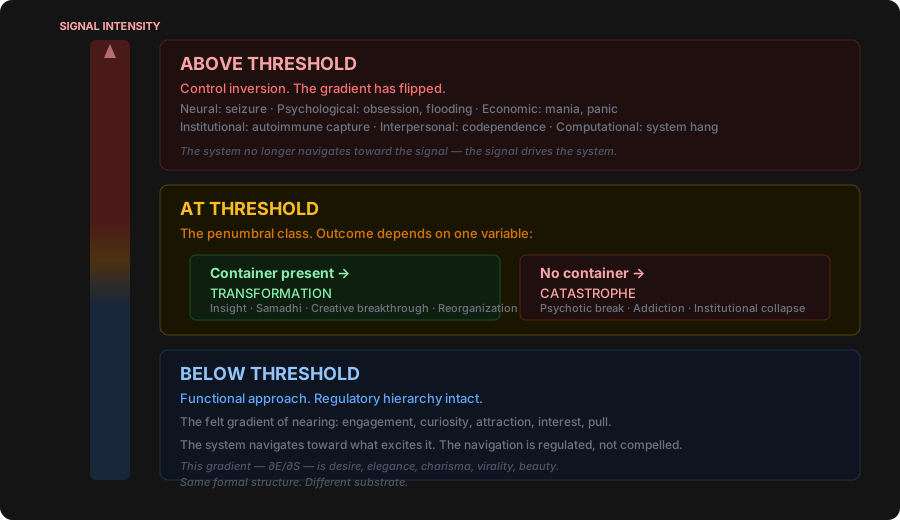
When local dynamics at level N exceed the regulatory variety at level N+1, control inverts. The subsystem becomes sovereign. The emotional subsystem that floods the ego. The compliance apparatus that captures the institution. The speculative feedback loop that overwhelms price-discovery. The cell that stops responding to organism-level regulation.
The gradient of near-threshold excitation — ∂E/∂S — is desire, elegance, virality, charisma. Same formal structure. Different substrate.
The container makes the difference. Same threshold, same signal — contained inversion produces insight, uncontained produces seizure.
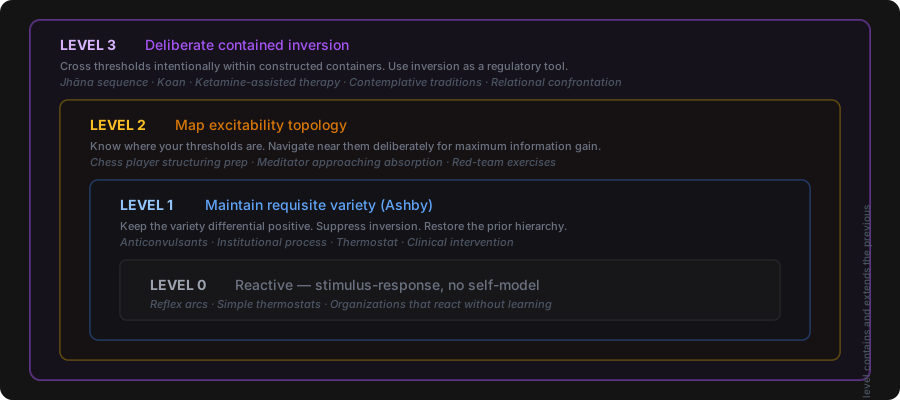
The third level — deliberate threshold-crossing within constructed containers — is the contemplative traditions as engineering manuals. The koan. The jhana sequence. Ketamine-assisted therapy. The therapeutic relationship at its highest capacity. And because excitability topology is in principle mappable, the paper proposes a perturbation–recovery protocol — the echo protocol — for locating a system’s position in it and detecting pre-inversion signatures before the threshold is crossed.
This post states the structures. The papers perform them — they habituate the discriminations through sequential exercise rather than summarizing them. The difference matters: reading about a distinction and making the distinction are not the same act. The papers are built so that by the end of each, the reader has practiced the moves, not just encountered the vocabulary.
Citations:
Close, L. J. (2026). Completability. Zenodo. https://doi.org/10.5281/zenodo.18512734
Close, L. J. (2026). Sufficiency. Zenodo. https://doi.org/10.5281/zenodo.18604070
Close, L. J. (2026). Excitability: A Post-Seizure Cybernetics of Control Inversion Across Substrates of Intelligence. Zenodo. https://doi.org/10.5281/zenodo.18627252