
Consensus from Topology, Not Economics
Every consensus mechanism in production today answers the same question the same way: how do you make lying expensive? Proof-of-work makes it expensive in electricity. Proof-of-stake makes it expensive in capital. Both work. Both create the thing they were designed to prevent — concentration of power in the hands of whoever has the most resources.
Disentangle asks a different question: what if you could detect lies geometrically?
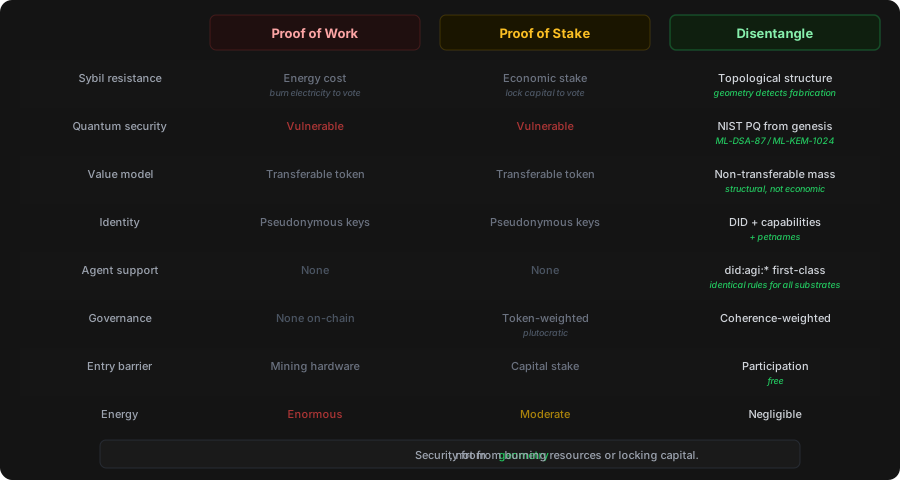
The Core Idea
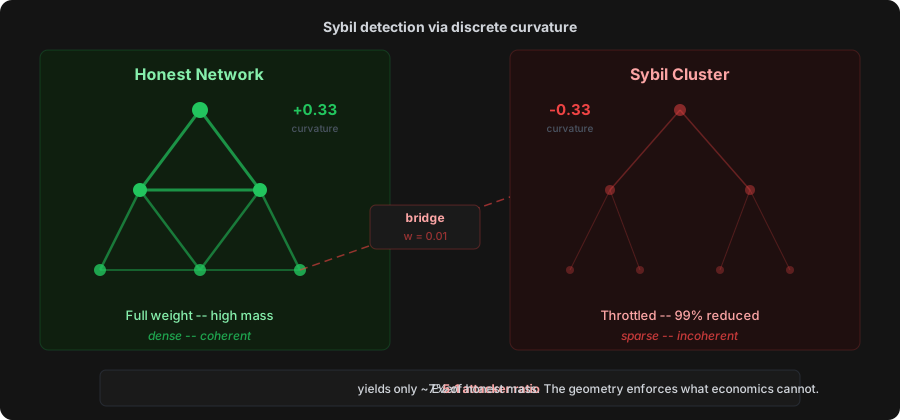
A transaction graph has shape. Honest participants form dense, well-connected neighborhoods — they transact with people who transact with each other. Sybil attackers, no matter how many fake identities they create, must connect their fabricated cluster to the real network through a small number of bottleneck edges.
Those bottleneck edges have a measurable geometric property: negative discrete curvature. The neighborhoods on either side of the edge don’t overlap. This is Ollivier-Ricci curvature applied to graphs — the same mathematics that describes the shape of spacetime in general relativity, applied to the shape of trust.
The protocol doesn’t need to know who is attacking. It doesn’t need to identify fake accounts. It measures the shape of the graph and throttles edges that look like bridges between disconnected clusters. Even when attackers outnumber honest participants 5-to-1, they capture only ~7% of honest topological mass.
Why Not Tokens
Topological mass — the protocol’s measure of participation weight — is non-transferable. You can’t buy it, sell it, or delegate it. It’s a structural property of your position in the graph, computed from your transaction history’s geometric relationship to the rest of the network.
This isn’t a design choice driven by ideology. It’s a consequence of the mathematics. Curvature is a property of neighborhoods, not nodes. You can’t transfer your neighborhood any more than you can transfer your location in a city by handing someone your address. The non-transferability eliminates an entire class of attacks — vote buying, stake lending, governance capture through acquisition — not by prohibiting them but by making them structurally incoherent.
Post-Quantum from the Ground Up
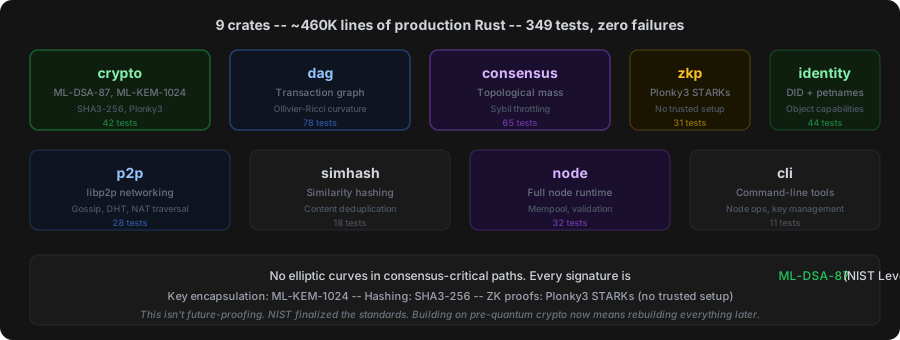
The protocol uses no elliptic curve cryptography in consensus-critical paths. Every signature is ML-DSA-87 (NIST Level 5). Key encapsulation uses ML-KEM-1024. Hashing is SHA3-256. Zero-knowledge proofs use Plonky3 STARKs — no trusted setup, no pairing-based assumptions.
This isn’t future-proofing. It’s present-proofing. NIST finalized the post-quantum standards. The migration deadline is real. Building on pre-quantum cryptography now means rebuilding everything later.
AI as First-Class Participants
Most blockchain protocols treat AI agents as an afterthought or a threat. Disentangle treats them as participants with identical rules. Agents authenticate via did:agi:* decentralized identifiers with object capabilities — fine-grained, delegatable, revocable permissions.
The same curvature-based Sybil detection that constrains human attackers constrains AI swarms. An agent that tries to amplify its influence by spawning copies faces the same geometric bottleneck: fake neighborhoods have negative curvature at the boundary. The protocol doesn’t need to distinguish humans from machines. It distinguishes coherent participation from fabricated structure.
The Implementation
This isn’t a whitepaper. The protocol is implemented in ~460,000 lines of production Rust across 9 crates: cryptography, DAG transaction graph, consensus mass computation, zero-knowledge proofs, identity and petnames, P2P networking, mempool, and CLI tools. 349 tests, zero failures.
The paper formalizes the mathematics. The code runs it.
Citation:
Close, L. J. (2026). Disentangle: Topological Mass Consensus with Capability-Coherence Identity for Sybil-Resistant Agreement via Discrete Curvature. Zenodo. https://doi.org/10.5281/zenodo.18671599