The Protocol and the Ground

You come back from a ten-day silent retreat having directly perceived that the boundary between self and world is a construct. The insight is not a theory. It is the most vivid thing you have ever experienced.
Within a month you have quit your job, ended a stable relationship, and begun telling friends that their attachment to “conventional boundaries” reflects their spiritual immaturity.
The insight was real. The translation into action was a disaster.
This is one of the most common failure patterns in serious contemplative and psychedelic practice, and there was no formal protocol for preventing it. The work that builds one now spans two papers, split along its natural joint: Phase-Indexed Epistemology is the protocol — the discipline you can practice. Derivation is the ground — the formal chain that secures the protocol’s central metric, now machine-checked in Lean 4.
The Problem
Different states of consciousness disclose different things. Deep meditation discloses the constructed nature of boundaries. Psychedelic states may disclose relational structures below ordinary perception. Ordinary waking consciousness discloses operational causality and intersubjective verification. Each disclosure is real. Each has blind spots.
Integral theory’s state/stage distinction — one of its most important contributions — describes this territory: states are temporary conditions of consciousness, stages are the relatively stable structures of meaning-making through which a state’s disclosures get interpreted. The Wilber-Combs lattice tells you that a rationalist and a mystic can both enter nondual awareness and will interpret it differently. What it does not provide is a protocol for the question that comes after: what do you do with a truth-claim generated in one state when you return to another? Hold it? Act on it? Translate it? Discard it as artifact? The model is silent.
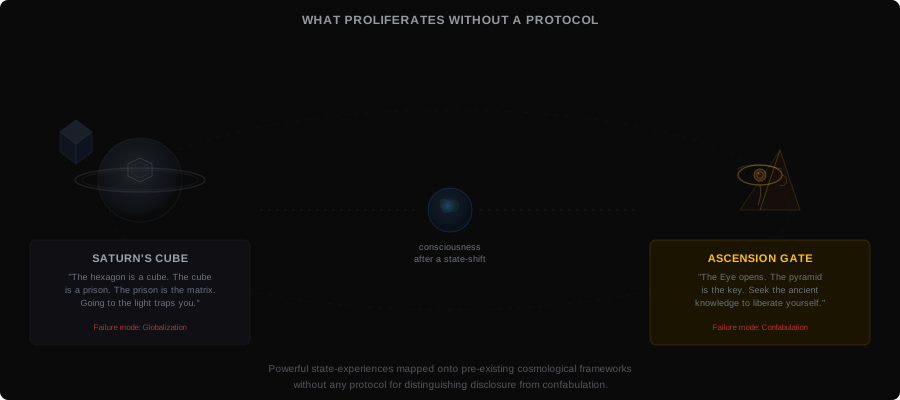
Without a protocol, practitioners default to three predictable errors.
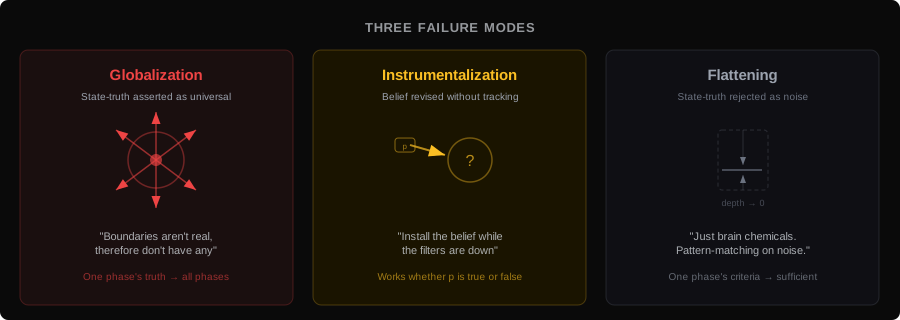
Globalization: state-specific truth asserted as universal. You perceive the constructed nature of boundaries in samadhi and treat all operational boundaries as illusions. A friend describes genuine financial distress; you respond that “it’s all part of the unfolding.” The nondual doesn’t negate the conventional — it contextualizes it. Globalization collapses that distinction.
Instrumentalization: belief revised during a shifted state without tracking the generating conditions. Micro-dosing to install affirmations before a sales call. Retreat settings engineered to soften critical filters before offering a new belief framework. The mechanism is identical whether the implanted belief is “I am fundamentally worthy of love” or “my guru is infallible.” Only the content differs. Without tracking, there is no structural difference between legitimate restructuring and manipulation.
Flattening: state-truth rejected because it fails ordinary-state verification. “That was just brain chemicals.” This feels like rigor, but it’s the same formal error as globalization — universalizing one phase’s criteria as sufficient. The gross waking state becomes the silent universal arbiter, not because there’s an argument for its completeness, but because it’s the default.
Notice the symmetry: globalization universalizes from the state side, flattening universalizes from the gross side. Both treat one phase’s disclosures as exhaustive.
The paper goes further and locates these errors developmentally: each developmental level is an epistemic codec — different dimensionality, different compression characteristics, different structural blind spots. Rational-modern consciousness tends toward Flattening, not because its tools fail but because their completeness is assumed where only power obtains. Pluralistic-postmodern consciousness tends toward Globalization, because it correctly suspects all claims to non-perspectival ground and so cannot rank any state’s disclosures above another’s. Integral consciousness has the capacity for phase-indexing — but capacity without protocol is hardware without software.
The Protocol
Phase-indexing provides the third option: precision without reductionism. Every truth-claim gets tagged with its generating conditions.
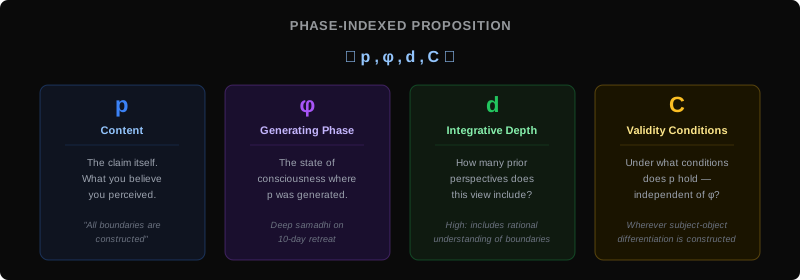
The schema is simple: what you claim, where it was generated, how much structure it holds, and under what conditions it’s valid — specified independently of the generating state. When the validity conditions and the generating phase diverge, the proposition becomes epistemically productive. When they’re identical, it’s phase-locked — valid only within its generating state.
Translation across phases has five possible outcomes:
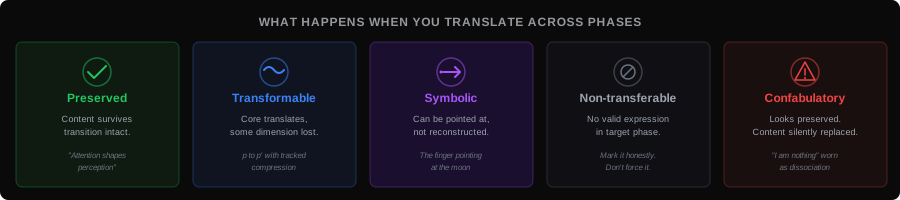
The dangerous one is confabulation. You experience the emptiness of self — the direct perception that “I” is a contingent process. You return to daily life and translate this as “I don’t really exist,” which you use to dismiss your own needs and avoid conflict. The surface language points at the original insight. The functional content has been silently replaced by a dissociative strategy wearing the original’s clothes.
Distortion has more than one entry point, and the protocol tracks all of them: a belief is generated in one phase, retained (or transformed) across the transition to another, and asserted in a third — a conversation, a decision, a public claim. Each transition is a potential site of distortion, and without the full chain there is no way to locate where the distortion entered. In practice, it looks like this:
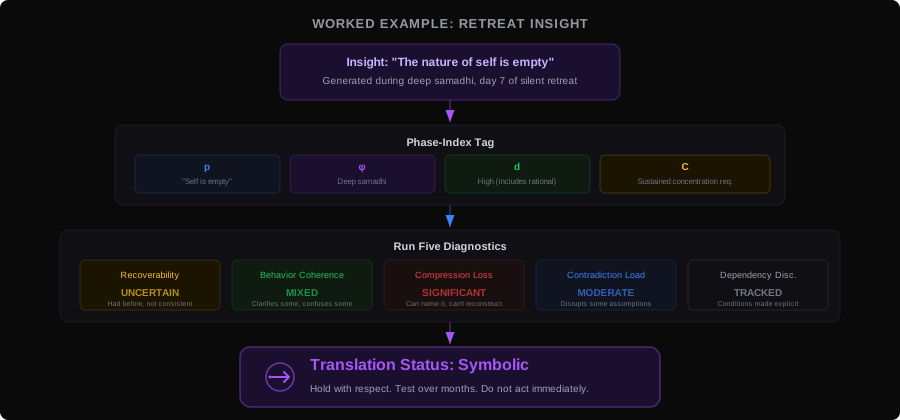
Not dismissing the insight, not globalizing it — tracking its provenance and translation status with enough precision to work with it responsibly.
The capacity to do this is itself a developmental line, and the paper maps it: from no awareness that beliefs have generating conditions, through recognition without protocol, to explicit tagging, to deliberate navigation between states with indexing maintained. Beyond navigation lies a structurally distinct capacity the traditions named with words like theoria, jñāna, and prajñā — not tracking translations between phases but recognizing the ground from which all phases arise. Which is where the second paper begins.
Why This Matters Now
For most of contemplative history, phase-indexing was handled implicitly by the practice container itself. A Zen student sat with a teacher for twenty years. State-shifts were gradual, supported, integrated within a stable relational framework. The teacher’s role was, in significant part, to provide phase-indexing feedback. Every major tradition developed its own version. They solved the problem, but locally, within their own containers, over timescales modern practitioners rarely have.
Three things have changed.
Pharmacological state-shifts now outpace integration capacity. A single high-dose psilocybin session produces experiences rated among the most meaningful of participants’ lives — on a timescale of six hours, without any prior contemplative training. State access has decoupled from lineage containers: meditation apps, weekend retreats, breathwork workshops deliver non-ordinary states without the relational infrastructure. And consensus reality itself is no longer a stable target phase — the ordinary waking state that insights must translate into is itself shifting.
More people are generating high-state insights than at any point in history, with less integration infrastructure than the traditions ever contemplated. The implicit approach is no longer sufficient.
The Ground
The protocol needs a depth metric — some way to say that one perspective genuinely includes and contextualizes another rather than merely differing from it. But ordering perspectives by depth seems to require standing outside all perspectives, which is the move the postmodernists correctly identified as suspect. Within the protocol paper the metric is used operationally: a partial order measured by compression loss across phase transitions. Its grounding is the work of the companion paper, Derivation.
Derivation resolves the problem by grounding the metric not in another perspective but in a formal derivation. The method is Descartes’s own: submit everything to radical doubt, identify what survives, build only from what is indubitable. The improvement is the starting point.
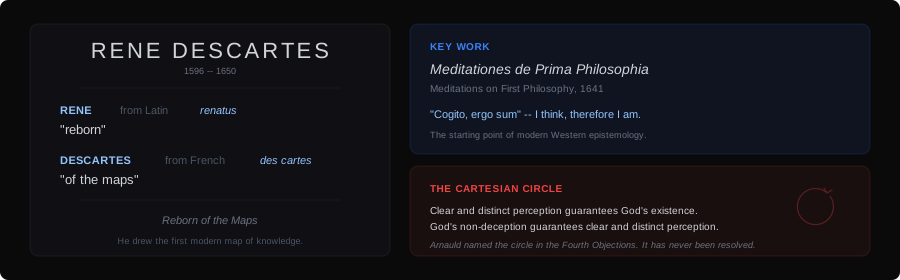
Descartes began with “I think.” This requires a knowing subject. He secured the subject’s reliability through clear and distinct perception, guaranteed by a non-deceiving God whose existence he demonstrated via clear and distinct perception. The circle has never been resolved.
The fix: begin earlier. Begin with what even the cogito presupposes.
There is. Something is. The radical skeptic cannot deny this because the denial itself is something that is. This is more indubitable than “I think” because it requires no thinker.
And it doesn’t stand alone. Recognition — even silent, even pre-linguistic — is always already both apprehending and apprehended. Try to reduce it: denying the duality performs an act of denial (apprehending) directed at a content (apprehended). The structure cannot be eliminated by any operation that is itself an instance of the structure.
From this primitive, the chain is forced. Not constructed — found.
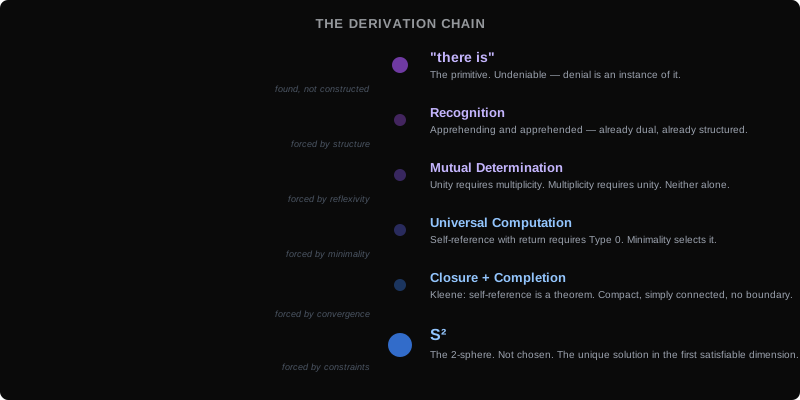
Each step yields structure the prior step did not contain. Recognition carries implicit perspectival frames — necessarily more than one. Unity and multiplicity are mutually determinative: neither exists without the other. Particular terms have only relative existence, arising in mutual dependence. What is actualized is rigorous epistemology itself, not the instantiations.
The chain’s self-referential structure requires Type 0 in the Chomsky hierarchy — universal computation, characterized structurally. At this threshold, Kleene’s recursion theorem proves that self-reference with return is a theorem, not an assumption. The metric completion of computation’s configuration space, with the requirement that consequence chains can close, forces a carrier that is compact, simply connected, and without boundary. Dimension 1 admits no solution. Dimension 2 admits exactly one: S². The 2-sphere is not chosen. It is the unique solution.

What the Traditions Had
The derivation provides a non-partisan evaluation criterion for structural claims embedded in the world’s contemplative and theological traditions. Not vindication — a common structural language that doesn’t require accepting any tradition’s contingent premises. Each correspondence is tested: given only the chain, would the traditional claim follow? Some claims pass, some partially pass, some remain indeterminate — and the variation is itself evidence that the framework discriminates rather than confirms.
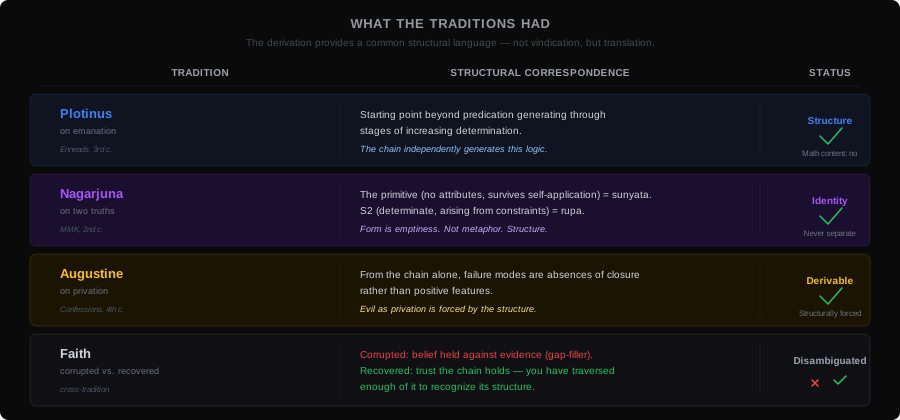
The mutual-exclusion framework was the error. What millennia of rigorous theological thinking produced becomes available to anyone, without requiring acceptance of the contingent premises those insights historically demanded.
Phase-Invariance Is the Point
The chain is no longer merely machine-checkable. It has been formalized and machine-checked in Lean 4: the artifact declares zero custom axioms and contains no sorry, and every top-level theorem reduces to the three standard axioms underlying Mathlib itself. Its central steps are proved rather than assumed — π₁(S²) = 0 via a Seifert–van Kampen development built from scratch, the dimension-1 exclusion (π₁(S¹) ≠ 0) via covering-space path-lifting, and closure at the universal-computation threshold via Kleene’s recursion theorem. The one irreducibly mathematical premise — the classification of surfaces, from which the uniqueness of S² follows — is carried as an explicit hypothesis the theorems quantify over, not smuggled in as an axiom.
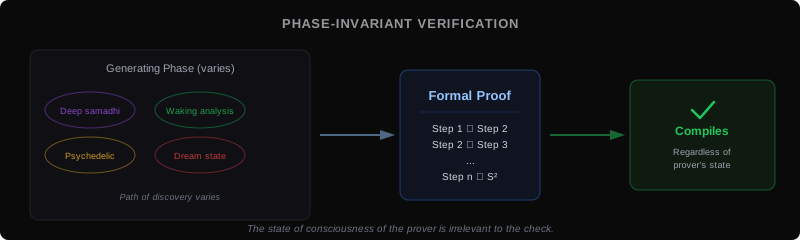
A proof compiles regardless of the prover’s state of consciousness. This is not a minor technical convenience. It means the chain has produced, from within itself, a mode of warrant immune to the phase-dependence that creates every failure mode the protocol paper identifies.
The postmodern objection — that any claim to non-perspectival ground covertly universalizes a particular perspective — fails against a chain whose derivation is overdetermined by independent formal considerations. That every independent formalization of “effective procedure” — Turing machines, lambda calculus, recursive functions, cellular automata — converges to the same boundary is evidence that the threshold is structural, not an artifact.
And the derivation is honest about its own limit. That the conditions are phase-invariant is not the same as their being adequate — whether the formal structure faithfully captures the insight it grounds cannot be judged from inside the formalism. The ground is checkable; the adequacy is not surveyable. This is the non-closure the derivation has been describing, turned on the derivation itself: the place you can stand and be certain is not a place from which you can see the whole.
Cavell saw the structure from the other direction: “If philosophy is esoteric, that is not because a few men guard its knowledge, but because most men guard themselves against it.” The derivation doesn’t overcome the defense by force of argument. It makes the defense visible — by providing a chain that anyone can check, that no one’s state of consciousness can invalidate, and that stands in the open for anyone willing to follow it.
The traditions could not prove the map was non-perspectival because they lacked the formal chain. The formalization doesn’t replace their insight. It removes the excuse for guarding against it.
The protocol — proposition schema, transition diagnostics, and the developmental line — is in Phase-Indexed Epistemology. The ground — the full derivation chain and its Lean 4 verification — is in Derivation, with the formalization at GitHub. More context on this and related work is on the research page.
Citations:
Close, L. J. (2026). Phase-Indexed Epistemology. Zenodo. https://doi.org/10.5281/zenodo.18811066
Close, L. J. (2026). Derivation. Zenodo. https://doi.org/10.5281/zenodo.21156830